| The opening paragraph of the L2APP learner
resources booklet begins:
"The Level 2 Award in Playwork Practice
(L2APP) has been developed to respond to the needs of the play and
playwork workforce as defined in Welsh Government's statutory guidance,
Wales - a Play Friendly Country (2014)." PWAL2018LAP001
Essentially the L2APP course needs to follow the guidelines of this
document. If we look at the document Wales
- a Play Friendly Country (2014) and it's introduction we will
see that it aligns itself with the United Nations Convention on the
Rights of the Child Articles 31, 15 and 12). From this document we can
see that the Welsh Assembly Government have agreed to follow the UNCRC
charter:
"Children’s right to play is enshrined in Article 31 of the United Nations Convention on the
Rights of the Child (UNCRC). The Welsh Government formally adopted the United Nations
Convention on the Rights of the Child in 2004, and we are committed to making the
principles of the UNCRC a reality for all children and young people. There are three articles
which particularly relate to this duty:
• Article 31 (Leisure, play and culture): Children have the right to relax and play,
and to join in a wide range of cultural, artistic and other recreational
activities, which must be read in combination with the General Comment No17 on the right of
the child to rest, leisure, play, recreational activities, cultural life and the arts (art. 31):
“The general comment seeks to enhance the understanding of the importance
of article 31 for children’s well-being and development; to ensure respect for and
strengthen the application of the rights under article 31”
• Article 15 (Freedom of association): Children have the right to meet together and
to join groups and organisations.
• Article 12 (Respect for the views of the child): When adults are making decisions
that affect children, children have the right to say what they think should happen and
have their opinions taken into account.
In Wales play is established as one of children’s rights under Core Aim 4 – Play, Sport,
Leisure and Culture, of the Welsh Government’s 7 Core Aims for Children, set out in
Children & Young People: Rights to Action, 2004."
WGOV2014PFC002
Both the United Nations Article 31, General Comment 17 and Wales - a
Play Friendly Country documents are quite clear in their definition of
childrens' rights and those of the government;
Article 31 states: "Children have the
right to relax and play and to join in a wide range of cultural,
artistic and other recreational activites" - UNAT1989CRC003
General Comment 17 confirms the Welsh Assembly Government's
obligations:
"(h) Training and capacity - building:
All professionals working with or for children, or whose work impacts on children
(Government officials, educators, health professionals, social workers,
early years and care workers, planners and architects,etc.), should
receive systematic and ongoing training on the human rights of children, including
the rights embodied in article 31. Such training should include guidance on
how to create and sustain environments in which the rights under article 31 can be
most effectively realized by all children" - UNAT2013GCO003
(g)Participate freely: The right of children to participate
freely in cultural life and the arts requires that States parties respect and
abstain from interfering in the child’s access to, choice of and engagement in such activities, subject to the obligation to
ensure the
protection of the child and the promotion of the child’s best interests. States parties
must also ensure that others do not restrict that
right. The child’s decision to exercise or not exercise this right is his or
her choice and, as such, should be recognized, respected and
protected. - UNAT2013GCO008
"Wales - a Play Friendly Country" defines play as
"Play is defined for the purposes of the measure as including “any recreational activity”
(Section 11(6) Measure). The definition of play includes but is not limited to “any recreational
activity”. This recognises that children enjoy and benefit from taking part in a wide range
of activities that are, in the main, organised by adults for children. These can include junior
and youth clubs; leisure centre and sporting activities; cultural and arts activities; indoor play
centres, play buses and events organised for children and their families. These recreational
activities may offer a combination of adult led organised activities, and opportunities for
freely chosen and child led play. In any of these situations children should have the choice
of taking part and a voice in what opportunities are offered and how they are organised.
We see the range of play opportunities for children that are covered under the Measure
as being:–
• Freely chosen Play – With or without adult supervision/facilitation.
• Structured recreational activities – in the main led by adults, with predefined rules.
These opportunities can be available in a range of spaces and settings and any setting may
afford both opportunities for freely chosen play and structured recreational activities"
- WGOV2014PFC014-05
The definition of play quoted here in the 2014
is the legal definition taken from the Children and families (Wales)
measure 2010. In a nutshell both the United Nations and the Welsh
Assembly Government's policies indicate that a child is entitled to
play, leisure, rest, recreation, the arts and cultural activities and
the term 'play' covers all these. If we refer again to the first
paragraph of the L2APP course.
"The Level 2 Award in Playwork Practice
(L2APP) has been developed to respond to the needs of the play and
playwork workforce as defined in Welsh Government's statutory guidance,
Wales - a Play Friendly Country (2014)." - PWAL2018LAP003
This being the case we would expect the L2APP
course to follow the United Nations and Welsh Assembly Government's
policies with regards to play covering the whole spectrum of play, recreational activities
and rest. However it does not. If we refer to the very first paragraph
of the course under the heading "Unit 1 - Understanding a Playwork
Approach" immediately the course begins to follow its own agenda,
the Playwork Principles.
"Playworkers work according to the
Playwork Principles. These are values and beliefs that playworkers have
agreed are central to what we do. they describe what is special about
play and playwork. They help to explain the role of the playworker and
establish a professional and ethical framework for the playwork
profession" - PWAL2018LAP006
The Playwork Principles are a collection of play related statements
that were agreed by the Playwork Principles Scrutiny Group 2005. The Playwork Principles Scrutiny Group
were a number of people who were invited by Play Wales to form a 'play
focus' group. Play Wales motives in the formation of this group are
questionable.
CLICK
HERE FOR MORE ABOUT THE PLAYWORK PRINCIPLES
The
'Playwork Principles' view of play is defined in the Playwork Principle
2:
2 - "Play is a process that is freely
chosen, personally directed and intrinsically motivated. That is,
children and young people determine and control the content and intent
of their play, by following their own instincts, ideas and interests, in
their own way for their own reasons" PWAL2018LAP007
Playwork principles 3, 4 and 5 state that the playworker should
support this process and no other:
"3 - The prime focus and essence of playwork is to support and facilitate the play process and this should inform the development of play policy, strategy, training and education."
"4 - For playworkers, the play process takes precedence and playworkers act as advocates for play when engaging with adult led agendas."
"5 - The role of the playworker is to support all children and young people in the creation of a space in which they can play."
Adult led agendas in playwork principle 4 is
everything that is not instinctive play. - PWAL2018LAP012-07 - PWAL2018LAP012-07.
This is the reason why on page 10 of the course booklet we find
a major case of deception and manipulation by the L2APP course booklet author. The booklet author wants students
to believe that the course follows the guidelines of United Nations
Article 31 and General Comment 17 so rather than include the United
Nations information alongside
Wales - a Play Friendly Country in the background to the qualification, prior to the course start, which is its natural position, he has hidden
it amongst the Playwork Principles, between numbers two and three. If
we look at the wording of article 31
"Article 31:
1. States Parties recognize the right of the child to rest and leisure, to engage in play and recreational activities appropriate to the age of the child and to participate freely in cultural life and the arts.
2. States Parties shall respect and promote the right of the child to participate fully in cultural and artistic life and shall encourage the provision of appropriate and equal opportunities for cultural, artistic, recreational and leisure activity."
- PWAL2018LAP010-08to09
We see that it suggests a broad range of interests for
children including "cultural, artistic, recreational and leisure
activity"
then look at how Article 31 is represented by Play
Wales:
"In effect, Article 31 says that children have a right to play and that governments should provide opportunities for children to play"
- PWAL2018LAP010-10
If we refer again to the Play Wales definition of play which is:
"Play is a process that is freely
chosen, personally directed and intrinsically motivated. That is,
children and young people determine and control the content and intent
of their play, by following their own instincts, ideas and interests, in
their own way for their own reasons"
We can see that the author here is attempting to mis-represent article
31. The author has just spent four pages drilling it into students what his
definition of play is. To the author play is not rest, it is not recreation or leisure,
and it certainly is not cultural activities, sport or the arts it is not even the Welsh
Assembly Government definition of play which is:
"Play is defined for the purposes of the measure as including “any recreational activity”
The author states that play is:
"......a process that is freely
chosen, personally directed and intrinsically motivated. That is,
children and young people determine and control the content and intent
of their play, by following their own instincts, ideas and interests, in
their own way for their own reasons"
...... and nothing else. Adults have no place in Play Wales
definition of 'play.
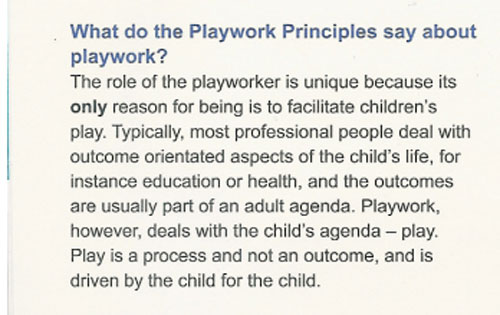
"Typically most professional people deal with outcome
orientated aspects of the child's life, for instance education or
health, and the outcomes are usually part of an adult agenda. Playwork
however, deals with the child's agenda - play. Play is a process not an
outcome, and is driven by the child for the child."
PWAL2018LAP012-01202 - PWAL2018LAP012-02
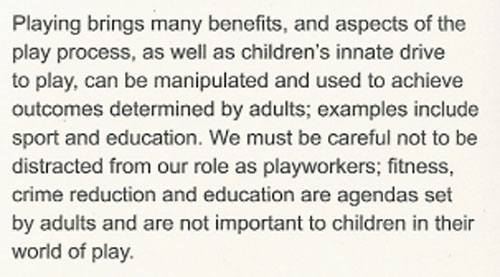
"... children's innate drive to play, can be manipulated and
used to determine outcomes determined by adults, examples include sport
and education". We must be careful not to be distracted from our
role as playworkers, fitness, crime reduction and education are agendas
set by adults.... PWAL2018LAP012-p07"
However General Comment 17 on Article 31 has a totally contrasting
view of the role of adults in children's play. Both play and recreation can take place when children are on their own, together with their peers or with supportive adults. Children’s development can be supported by loving and caring adults as they relate to children through play. Participation with children in play provides adults with unique insights and understanding into the child’s perspectives. It builds respect between generations, contributes to effective understanding and communication between children and adults and affords opportunities to provide guidance and stimulus. Children benefit from recreational activities involving adults, including voluntary participation in organized sports, games and other recreational activities." -
UNAT2013GCO002-P03 Another
form of deception can be found when Play Wales make an attempt to
associate the Playwork Principles and
Article 31 by placing Playwork Principle 1 on the UNCRC page
without relevance. There is no text leading into or out of it, Playwork
Principle 1 mysteriously appears for no known reason.
A search of the documents Wales - a Play Friendly Country, UNCRC Rights
of the Child and General Comment 17 will show that these documents do
not mention the Playwork Principles. The reason for this is that the way
L2APP wishes the way the Playwork Principles to be interpreted contradict the aims of both the United Nations and
Welsh Assembly Government publications. This method of deception is
repeated on page 40 where the author gives priority to the Playwork Principles
above the health of children.
Further to mis-representing Article 31 the document author has on
page 11 completely glossed over the General Comment 17 content with a summary of the
document. General Comment 17 is an extensive document which almost
always partners 'play and recreation' together.
"Play and recreation are essential to the health and well-being of children and promote the development of creativity, imagination, self-confidence, self-efficacy, as well as physical, social, cognitive and emotional strength and skills. They contribute to all aspects of learning; they are a form of participation in everyday life and are of intrinsic value to the child, purely in terms of the enjoyment and pleasure they afford. Research evidence highlights that playing is also central to children’s spontaneous drive for development, and that it performs a significant role in the development of the brain, particularly in the early years.
Play and recreation facilitate children’s capacities to negotiate, regain emotional balance, resolve conflicts and make decisions. Through their involvement in
play and recreation, children learn by doing; they explore and experience the world around them; experiment with new ideas, roles and experiences and in so doing, learn to understand and construct their social position within the world.
- UNAT2013GCO002-09
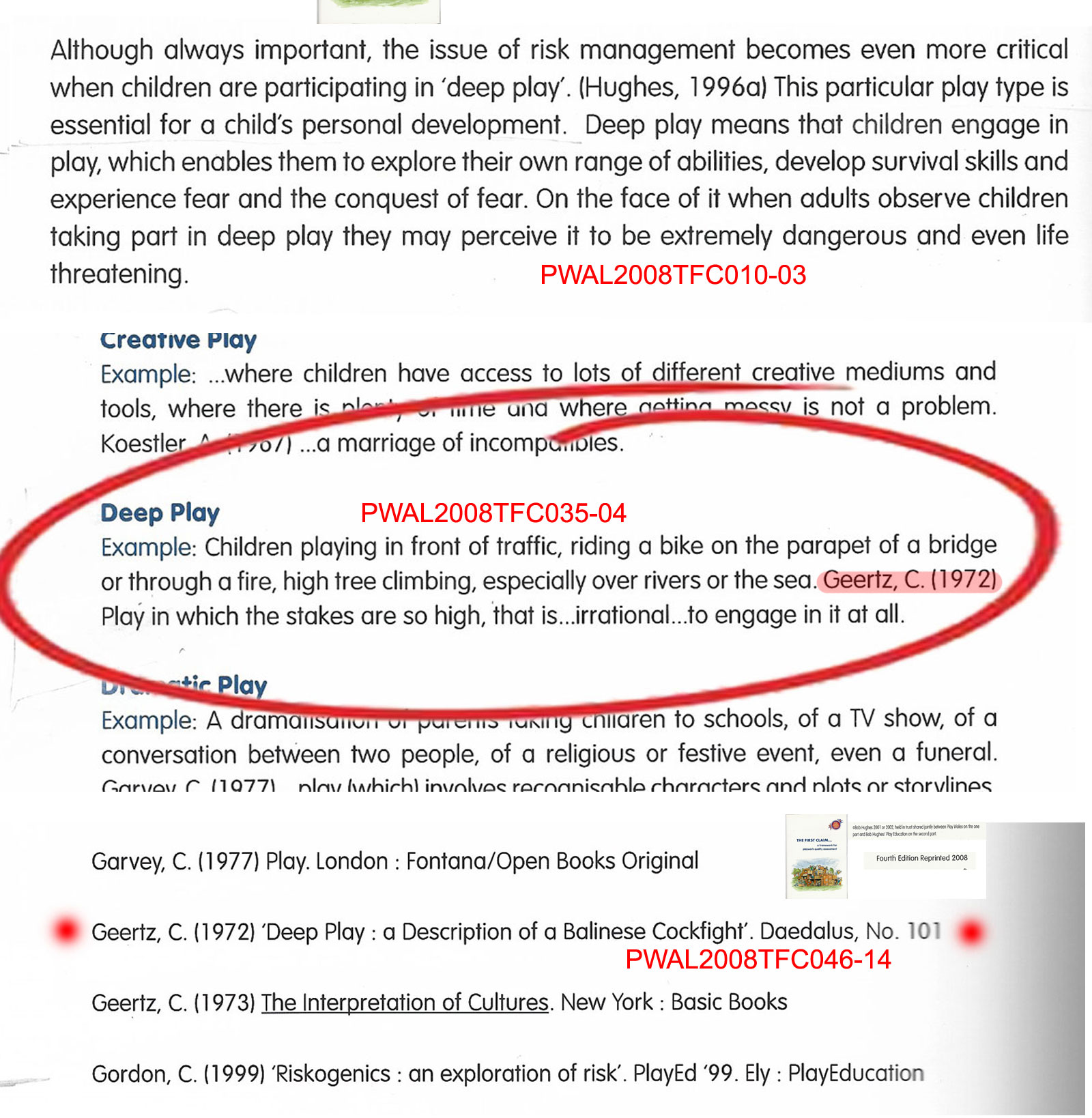
The only time we find
the 'Play Wales' definition of play in the document is when it has to
separated from recreation so that a legal
definition of 'play' can be given. Here 'play' can be found alongside and is
given parity with rest, leisure, recreational activities, cultural life
and the arts. Recreation according to the UNCRC is any activity chosen
voluntarily by a child.
"Recreation is an umbrella term used to describe a very broad range of activities, including, inter alia,
participation in music, art, crafts, community engagement, clubs, sports, games, hiking and camping, pursuing hobbies."
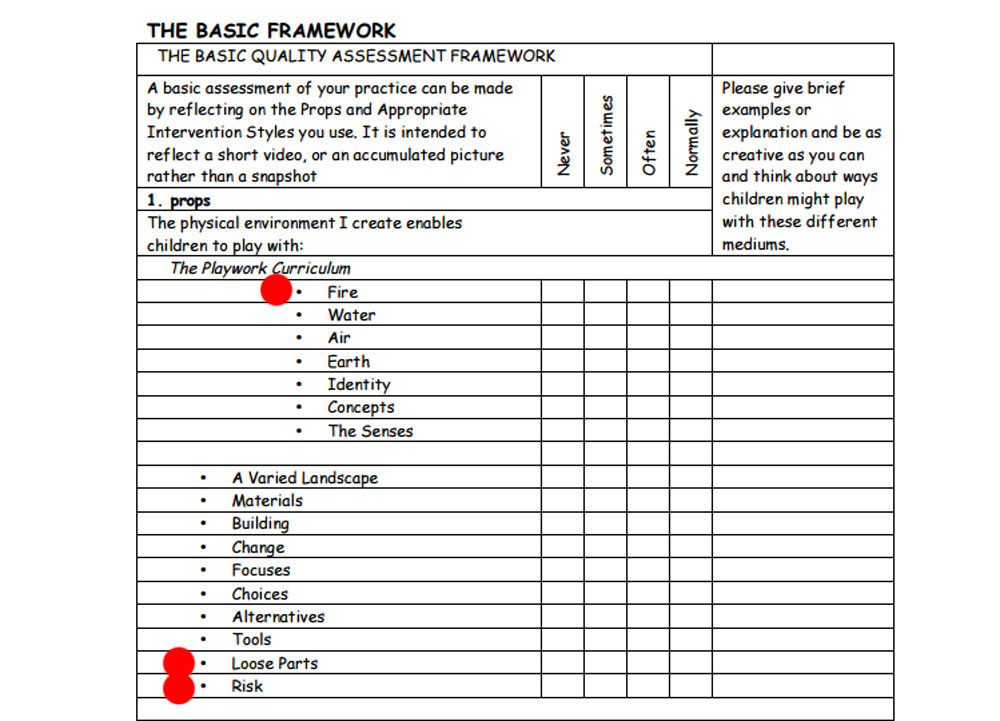
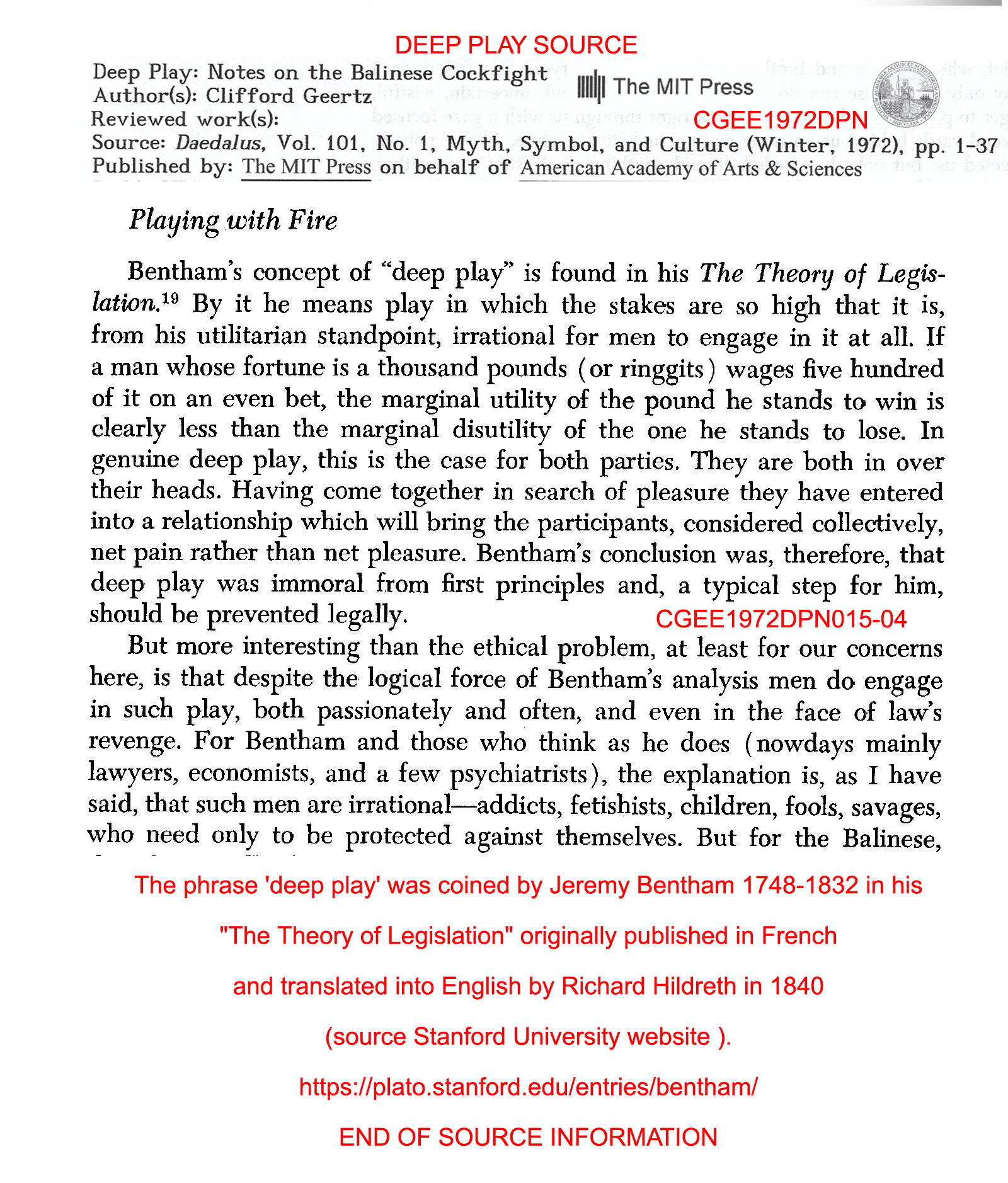
The objective of L2APP is to remove the above structured play options
and replace them with instinctive play only along with 'playing with
fire', loose parts (playing with rubbish) and play through taking
physical risks. The author is deceiving students so that
he can promote the Playwork Principles
and his definition of 'play' as opposed to the correct definition of 'play'
which appears in the documents on which the course should be based "Wales a Play Friendly Country
2014" (“any recreational activity”), the UNCRC
Article 31 ("Children have the right to relax and play,
and to join in a wide range of cultural, artistic and other recreational
activities") and General Comment 17 on this charter
(rest, leisure, play, recreational activities, cultural life and the
arts).
This is
deception which has no place in an educational publication or a
government funded organistaion.
|